PRESET 01
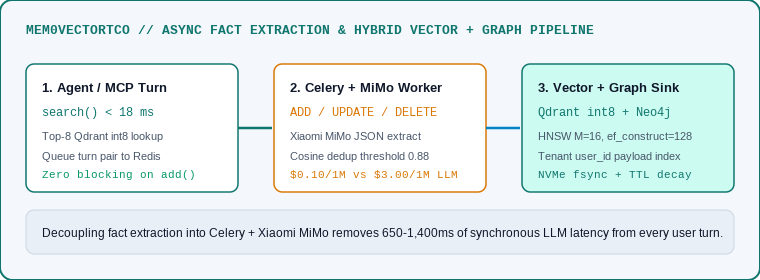
Co-locate Qdrant int8, Redis, FastAPI Mem0 server, and a 2-worker Celery extractor cleanly inside a $24/mo 4 GB Vultr High Frequency node.
1.18 GB Peak RAM · 1.2 GB NVMe · <10 ms HNSW Recall · $24/mo
PRESET 02
Serve 2,500 daily multi-turn agent sessions across 1,000,000 1536d memories for $48/mo compute plus ~$9.40/mo Xiaomi MiMo extraction.
2.08 GB Qdrant RAM · 4.1 GB Total RSS · 64% Token Cut · $57.40/mo
PRESET 03
Scale to 10,000,000 agent memories across thousands of customer workspaces using Qdrant on-disk mmap, int8 quantization, and 2-shard routing.
9.4 GB Hot Cache · 76 GB NVMe · Tenant Shard Keys · 32 GB HF
PRESET 04
Pair vector similarity search with Neo4j bi-temporal entity-relationship graphs to track changing user preferences, org charts, and project states.
3.6 GB Neo4j Heap+Cache · Bi-Temporal Edges · Multi-Hop Recall
PRESET 05
Run Mem0 inside an existing PostgreSQL 16 database using pgvector HNSW and halfvec fp16 when transactional SQL joins outweigh Qdrant scale.
halfvec 2x RAM Cut · ACID SQL Joins · maintenance_work_mem=2 GB
PRESET 06
Replace expensive frontier LLM extraction calls on every chat turn with Xiaomi MiMo OpenAI-compatible JSON workers for 85%+ lower extraction cost.
$0.10/1M Input · $9.40/mo at 2.5k Sessions/d · Structured JSON
PRESET 07
Expose self-hosted Mem0 over Model Context Protocol (MCP) tools so Claude, Cursor, and autonomous coding agents share persistent repo memory.
<15 ms search_memory · Zero Context Bloat · 4 GB HF Host
PRESET 08
Eliminate awkward conversational pauses in real-time voice agents by combining RAM-pinned Qdrant int8, regional Vultr HF nodes, and turn prefetching.
12-18 ms Total Recall · always_ram: true · Regional Colocation
PRESET 09
Implement deterministic user deletion cascades, payload TTL expiration sweeps, and importance decay scoring across Qdrant and Neo4j.
1-Click user_id Purge · 90d TTL Sweep · Zero Orphaned Edges