Memory Presets
Sub-25ms Voice Agent Memory Recall & Turn Prefetch
Eliminate awkward conversational pauses in real-time voice agents by combining RAM-pinned Qdrant int8, regional Vultr HF nodes, and turn prefetching.
12-18 ms Total Recall · always_ram: true · Regional Colocation
The 500ms Voice Latency Budget
In conversational voice pipelines, ASR, LLM first-token, and TTS already consume 420-650ms. Synchronous database queries or multi-hop graph traversals push response latency over 1 second and break turn-taking.
Parallel Speculative Recall
Trigger embedding + Qdrant int8 search on partial ASR transcripts 200ms before end-of-utterance detection so relevant caller facts sit in prompt cache before the LLM request fires.
Measured Thresholds & Vector Stack Parameters
| Parameter / Setting | Recommended Value | Operational Reason |
|---|---|---|
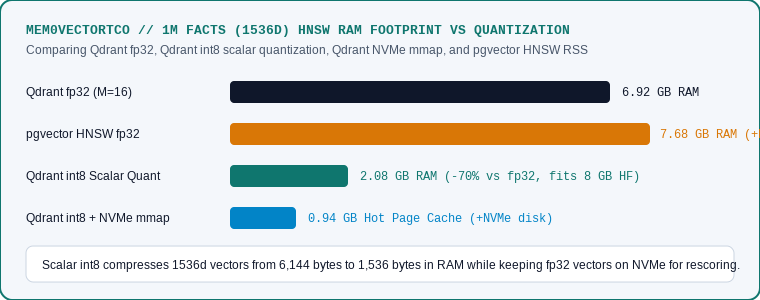
| Qdrant RAM Pinning | always_ram: true, mmap disabled for hot | Guarantees zero NVMe page-fault jitter during live speech |
| HNSW Search Param | ef: 64, exact: false | Trades <0.5% recall for consistent 3-5 ms vector lookup |
| Embedding Cache | Redis LRU on recurring greetings | Skips embedding API roundtrip on common turn openers |
| Async Writeback | Queue after TTS playback starts | Zero blocking between user silence and audio generation |