Memory Presets
Production SaaS 1M Facts on Qdrant int8 + Vultr 8 GB
Serve 2,500 daily multi-turn agent sessions across 1,000,000 1536d memories for $48/mo compute plus ~$9.40/mo Xiaomi MiMo extraction.
2.08 GB Qdrant RAM · 4.1 GB Total RSS · 64% Token Cut · $57.40/mo
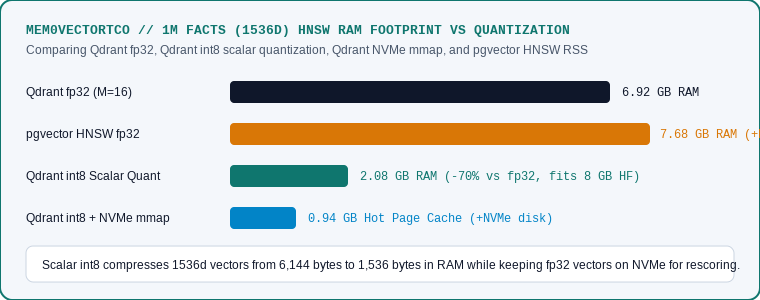
Why 1M 1536d Vectors Break Unquantized 8 GB Nodes
At 1,000,000 facts in fp32 precision, raw 1536-dimensional embeddings plus HNSW M=16 links consume nearly 7 GB before Python workers or segment compaction start. Enabling Qdrant scalar int8 shrinks active vector RAM to ~2.08 GB, making an 8 GB node rock-solid.
Enforcing Tenant Payload Indexes
Create keyword payload indexes on user_id and agent_id immediately upon collection creation so HNSW graph traversal filters per-tenant subgraphs in sub-18ms latency.
Measured Thresholds & Vector Stack Parameters
| Parameter / Setting | Recommended Value | Operational Reason |
|---|---|---|
| Vector Footprint (1M x 1536d) | int8 RAM ~1.84 GB (+15% merge) | Cuts Qdrant RAM 70% vs 6.92 GB fp32 baseline |
| Payload Index Keys | user_id, agent_id (keyword) | Prevents full-collection scans on multi-tenant filters |
| Search Rescoring | oversampling: 2.0, rescore: true | Fetches fp32 candidates from NVMe to recover >99% precision |
| Host Match | Vultr High Frequency 8 GB | Leaves ~3.9 GB free for OS cache and spike protection |