HNSW & Token Tuning
Scalar int8 Quantization: Cutting Vector RAM 4x Safely
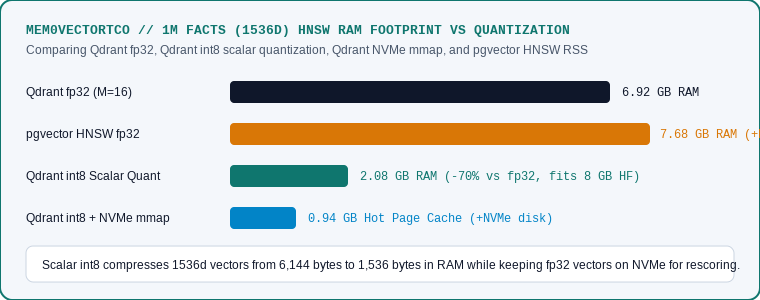
Compress 32-bit float embeddings to 8-bit integers in RAM while retaining full fp32 originals on NVMe for high-precision candidate rescoring.
6,144B -> 1,536B Vector · 99.1% Recall w/ 2x Oversample
Why quantile=0.99 Protects Quantization Accuracy
Extreme outlier coordinates in OpenAI or BGE embeddings can stretch linear min-max int8 buckets. Setting quantile: 0.99 clips the top 1% tails during calibration so 99% of vector coordinates keep sharp resolution.
How Two-Stage NVMe Rescoring Works
Qdrant traverses the HNSW graph using fast int8 vectors in RAM to gather 2 * K candidates, then reads only those 16-20 full fp32 vectors from High Frequency NVMe to compute exact final cosine rankings in under 2 milliseconds.
Measured Thresholds & Vector Stack Parameters
| Metric (1M x 1536d) | Unquantized fp32 | Scalar int8 (quantile=0.99) |
|---|---|---|
| Raw Vector Bytes/Point | 6,144 bytes | 1,536 bytes (4.0x smaller) |
| Total Qdrant RAM (M=16) | 6.92 GB RAM | 2.08 GB RAM (-70% incl. graph) |
| Recall@10 w/ Rescore | 99.4% baseline | 99.1% (oversampling: 2.0) |